

1. Code Before Content: Why Great Articles Die in the Dark
You pour massive budgets into high-tier content. You publish it. Crickets. Why? Because you built a mansion but bricked up all the doors.
Technical SEO is not a random plugin you activate to magically fix your rankings. It is the raw concrete foundation of your entire digital presence. If search engine bots cannot crawl and parse your code instantly, your world-class content is completely worthless. It dies in the dark.
The exact difference between a money-printing site and a dead one is code hygiene. Bloated sites packed with unnecessary JavaScript and heavy themes choke your server. Googlebot hates friction. It loves a clear, unobstructed path.
What You're Doing Wrong:
Running your site on heavy, off-the-shelf themes packed with useless plugins that drastically drain server resources.
Obsessing over the front-end aesthetics while leaving the backend code an unreadable, tangled disaster.
Treating Technical SEO as just generating a basic XML Sitemap and calling it a completed job.
The Tactical Fix:
Sanitize your codebase. Shift to a modern, lean architecture focused entirely on aggressive performance.
Ruthlessly delete any unnecessary plugins. Every single extra line of code is a roadblock for crawlers.
Treat your site like high-end software, not a basic blog. Clean code opens the floodgates for instant, reliable indexing.

2. Crawl Budget: Stop Wasting Googlebot's Gas
Google is not a charity. Search bots have a strict, limited amount of time and resources allocated to your specific site—your Crawl Budget.
Imagine Google gives you exactly 10 gallons of gas to explore your site. If your architecture is full of isolated Orphan Pages, or endless Redirect Chains that loop around indefinitely, that gas runs out before the bots ever reach your actual money pages.
The result? Your highest-converting pages simply don't get indexed. Or they get indexed months late, costing you thousands in lost revenue.
You must become brutally tactical with how you direct crawlers. Block the dead ends. Stop bots from crawling useless tag pages, faceted navigation, and dynamic filters. Force every single drop of that crawl budget directly toward the pages that actually print cash.
What You're Doing Wrong:
Leaving hundreds of dead 404 pages active, forcing bots to waste precious time crawling broken links.
Creating massive redirect chains (Page A redirects to B, B redirects to C). Googlebot gets exhausted, drops the session, and leaves.
Allowing search engines to crawl thousands of auto-generated, low-value URLs like internal search results or unoptimized product filters.
The Tactical Fix:
Plug the leaks. Use your robots.txt file aggressively to block crawlers from garbage areas of your site.
Fix your internal linking. Ensure zero money pages are orphaned; every critical page needs strong internal connections pointing to it.
Flatten your redirects. Ensure every old URL points directly to its final destination with a single, clean 301 redirect.
3. Rendering Architecture: The JavaScript War
JavaScript is a trap. Developers love it for the slick animations and real-time interactions. Search bots utterly despise it.
Imagine handing Google an unassembled IKEA box and saying, "Build it yourself to see what's inside." That is exactly what Client-Side Rendering (CSR) does. Googlebot is insanely busy. It does not have the computational budget to execute your heavy scripts just to read a paragraph of text. It drops the page. It moves straight to your competitor who served a fully rendered, ready-to-read HTML document.
To rank in 2026, you serve the meal fully cooked. Your server must do the heavy lifting.
What You're Doing Wrong:
Relying entirely on heavy CSR frameworks, forcing Googlebot to stare at a blank white screen upon initial load.
Hiding core content and critical internal links behind interactive JavaScript events (like "Click to Load" buttons). Bots do not click; they just leave.
Stuffing the with massive third-party tracking scripts that completely block the main thread and halt indexing.
The Tactical Fix:
Shift the burden to the server. Implement strict Server-Side Rendering (SSR) or Static Site Generation (SSG) so search engines ingest pure HTML instantly.
Deploy Dynamic Rendering for massive enterprise sites. Serve a lightweight, pre-rendered HTML snapshot to bots, and the full interactive app to users.
Flatten your DOM. Stop nesting elements 20 layers deep. A shallow, clean code structure guarantees lightning-fast crawling.
4. Log File Analysis: Spying on Search Bots
SEO tools lie. Well, they estimate. You open Ahrefs or Semrush, and the dashboard looks perfectly healthy.
The brutal, unfiltered truth lives in exactly one place: your Server Logs. This is the raw CCTV footage of your website. It shows you the exact millisecond Googlebot arrived, the precise URLs it requested, and the exact moment it hit a brick wall and left. This is where you uncover the catastrophic errors hidden from every other dashboard.
You will find silent 5xx server errors quietly assassinating your crawl budget while you sleep. You will discover Google is burning 80% of its time crawling useless faceted navigation URLs, entirely ignoring your high-ticket service pages. This isn't marketing anymore. This is technical espionage.
What You're Doing Wrong:
Blindly trusting Google Search Console's "Crawl Stats" as the absolute truth, even though it only provides a delayed, sampled fraction of the data.
Never requesting the raw Apache/NGINX logs from your DevOps team because they look "too intimidating" to read.
Shrugging off 5xx server errors as temporary glitches, oblivious to the fact that they actively destroy Google’s trust in your infrastructure.
The Tactical Fix:
Pull 30 days of raw log files. Dump them straight into a Log Analyzer and confront the actual reality of how bots interact with your architecture.
Track the Bot Hits. Pinpoint the exact garbage URLs Google is obsessing over, and forcefully redirect that crawl budget to your money pages.
Hunt down and eradicate 5xx errors. A 5xx error tells Google your server is unstable and unreliable. Fix your underlying hosting infrastructure immediately.
5. Site Architecture: The Tactical Blueprint for Links
Your site’s navigation menu isn't just there to look pretty. It is a strictly controlled tactical map.
When search bots hit your domain, they are hunting for one thing: Context. They need to figure out exactly what your site is about, and which "Boss" page deserves the ranking. If your internal linking looks like a randomized spiderweb—where every page links to every other page without logic—you are completely bleeding your Link Equity.
The 3-click rule remains absolute law. Any page on your website—especially the ones generating revenue—must be reachable within three clicks from the homepage. Nobody has the patience to dig through your directories to find a checkout page. Not the buyer, and certainly not Googlebot.
How to Escape the Randomization Trap: The disaster usually starts when you bury your core money pages deep inside unorganized sub-folders, praying Google discovers them by accident. That is self-sabotage. The fix isn't building more links; it’s building isolated, highly calculated Content Silos.
Lock down your categories. Articles in the "Marketing" silo should link exclusively up to the main "Marketing Services" page. They should never leak link juice to the "HR Software" section. This extreme focus injects your money page with massive, concentrated authority, forcing Google to recognize it as the ultimate industry pillar.
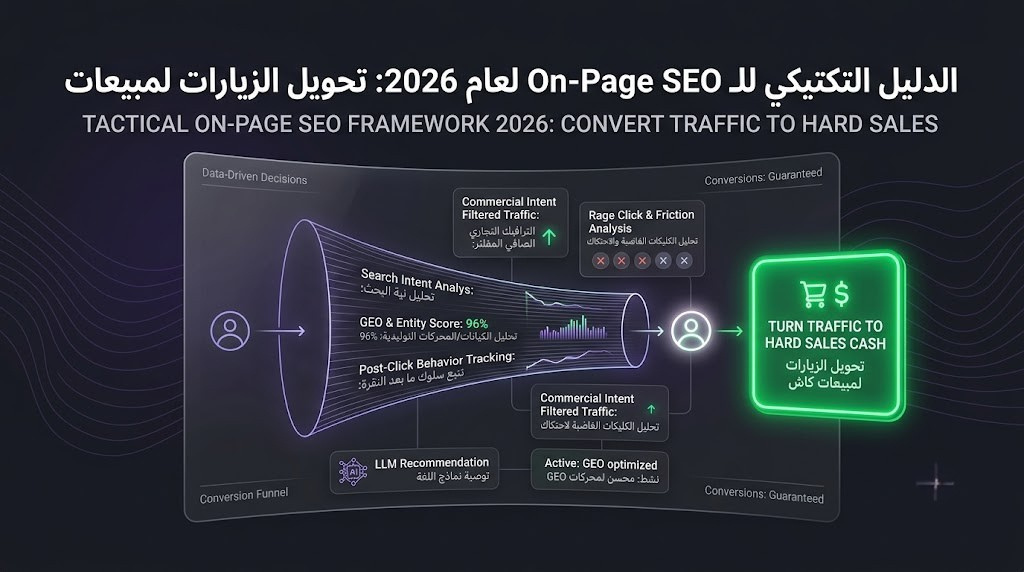
6. Core Web Vitals: The Speed Illusion and the INP Threat
In 2026, site speed no longer means "the page loaded in two seconds." The entire rulebook got rewritten.
You are now fighting a new monster: INP (Interaction to Next Paint). Google doesn't care when your hero image renders anymore. They track responsiveness. When a user clicks "Add to Cart" or opens a mobile menu, exactly how many milliseconds does the site take to react? If the browser freezes for even a fraction of a second, the user subconsciously assumes your system is cheap. Google spots this friction and drops your rank.
How to Eradicate the Bottleneck: You are living in an illusion if you celebrate a fast initial load time, completely ignoring the fact that your massive JavaScript bundles are aggressively choking the browser's Main Thread.
The hardcore technical fix starts with shredding your DOM size. Stop building pages with thousands of nested HTML nodes. Flatten the structure. Second, absolutely any script that isn't mission-critical in the first second (like chat widgets or secondary analytics) must be delayed. Let the user's browser breathe. Make sure it reacts instantly to the "Buy" button first, then load the secondary trash in the background.
7. Infrastructure Schema: Speaking Natively to Generative AI
Your e-commerce store isn't just a collection of pretty product shots. To Generative AI engines (LLMs), your store is simply a database of "Entities."
AI parsers don't read your lengthy, emotional product descriptions. They scan the backend for a native language they actually understand: Schema Markup. If you run a high-volume store and rely on free plugins that spit out basic, static schema, you are bleeding high-intent buyers.
The smartest architects are already abandoning heavy, bloated platforms. They are building lightning-fast headless storefronts (like Astro-based architectures designed to outpace standard Shopify performance). But speed alone isn't enough. Your schema must be deeply integrated into that codebase and update in real-time. The AI demands raw facts: Is this item strictly InStock? What is the live Price? Do you have a valid MerchantReturnPolicy?
How to Hack the LLMs to Push Your Products: A massive disaster happens when your product price updates on the frontend, but your cached schema still broadcasts the old price. The AI feeds the user the wrong number. They click, see a higher price, and bounce immediately. Google flags you for deceptive data.
The tactical solution for serious e-commerce is entirely dynamic JSON-LD injection. Hook your schema directly into your inventory database APIs. If an SKU goes out of stock, that schema updates in a millisecond. This hardcore technical accuracy is exactly what forces language models to recommend your store as the ultimate, reliable solution.
8. The Emergency Protocol: A 15-Minute E-Commerce Tech Audit
Do not wait until your revenue hits zero because Google quietly de-indexed your catalog. E-commerce Technical SEO requires aggressive, routine audits. You are maintaining a high-performance engine.
The absolute biggest nightmare for store owners is Faceted Navigation. A user searches for a shirt, clicks "Red," selects size "Large," and filters by brand. Your store automatically generates a unique URL for that specific combination. Suddenly, your tight 500-product catalog spawns 50,000 worthless URLs. Googlebot drops in, drowns in this infinite parameter matrix, and leaves without ever indexing your high-ticket items.
The Immediate Tactical Fix: Fire up Screaming Frog. Drop your domain in. You only need 15 minutes to expose the exact bottlenecks destroying your store.
First, instantly check your Crawl Depth. If your highest-margin products are buried 6 clicks deep, rip them out and hardcode internal links to them directly from your main category pillars. Second, slaughter the duplicate parameter URLs. Any link generated by a sorting filter (like ?color=red&size=m) must carry a strict Canonical tag pointing the bots back to the master product URL, or it needs to be completely blocked via robots.txt.
Fifteen minutes of ruthless technical auditing will salvage your crawl budget, force Google to index your actual products, and push those checkout pages straight to the top.