
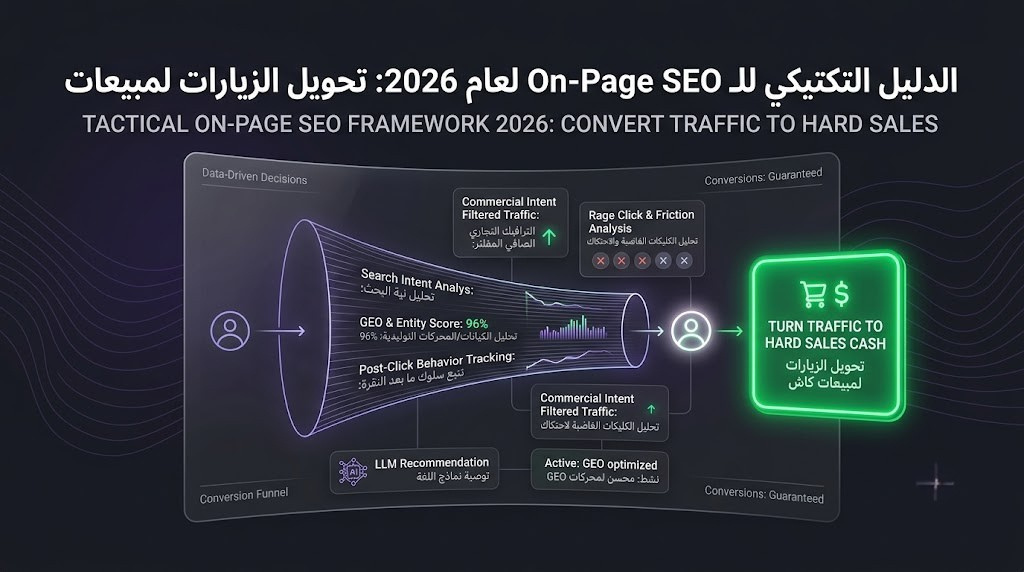
1. Traffic Filtering: Why AI Overviews Are the Best Thing for Your Sales
Google flipped the table. AI Overviews are swallowing search results whole.
Most SEOs are busy panicking over their plummeting traffic graphs. Look closer. This is actually the single best thing to ever happen to your conversion rates.
The End of "Empty Traffic"
AI just filtered out the tire-kickers. Users searching for basic definitions or surface-level tips? The AI feeds them right at the top. They grab their free fact and bounce. Let's be honest. That visitor was never going to buy your high-ticket service or complex software anyway.
What is the direct result? The traffic actually scrolling past the AI-generated answers to click your link is pure, unadulterated commercial intent. This is a buyer in pain. They have a specific business problem that a generic AI summary simply cannot fix. They are actively hunting for an expert.
How to Capitalize on This Shift
To win in 2026, your strategy needs a massive pivot:
Stop Torching Budgets: Kill the massive informational guides. No one reads them anymore.
Shift the Focus: Pivot your energy entirely to optimizing your money pages.
Target the Right Intent: Go aggressively after precise, transactional queries where the intent to buy is undeniable.
The noise is finally gone. The only people left are the ones holding their credit cards. The real question is: are your pages actually ready to close the deal?

2. Generative Engine Optimization (GEO): Make LLMs Your Sales Team
The game evolved. Keyword stuffing is ancient history. Language models don't read text like humans do; they connect "Entities."
To sell today, you must convince the machine you are the authority first, so it can sell you to the user.
The Official Death of FAQ Schema
Google just dropped a bomb. Remember the FAQ schema we all abused to dominate search real estate? FAQ schema officially dead. Google stopped showing them on May 7, 2026, and is pulling the Search Console reports entirely this June. If you're still mapping out content relying on FAQs for rich results, you're writing dead code.
So, what actually works now? Markup that defines your entity, not generic questions.
The Structured Data That Pays
To get recommended to a high-intent buyer by an AI, you have to speak its native language.
Feed the parser raw data: Pivot hard to deep, specific structured data (Product, SoftwareApplication, Course). This is the exact fuel AI parsers scrape to build their answers.
Position your brand as the fix: Tie your product directly to the user's pain point programmatically. Embed pricing, live reviews, and stock status directly into your markup.
Be the default answer: When a user asks an AI for a solution, the algorithm won't hesitate. If your data is structured perfectly, it will serve your brand name on a silver platter.
3. Information Gain: The Ultimate Tie-Breaker
So your schema is dialed in. The AI knows exactly who you are. Brilliant.
But what happens when the bots crawl your page and realize your copy is just a spun version of the guys already ranking? They ignore you instantly.
Google Penalizes Parrots
Google has declared all-out war on regurgitated, AI-generated fluff. The algorithm is actively hunting for "Information Gain." If your page doesn't bring a completely net-new fact, a fresh angle, or proprietary data to the table, there is absolutely zero mathematical reason for a search engine to rank you.
How do you manufacture exclusivity? Your internal data is your moat. Stop writing generic trash like "Why Site Speed Matters."
Write "How shaving 1.2 seconds off our load time spiked revenue by 24% last month."
Pull raw numbers from your CRM.
Drop real screenshots from your own analytics.
Document the A/B tests that failed miserably!
This is the exact content your competitors cannot scrape, and an AI cannot hallucinate.
Kill the Neutral Tone
A buyer with a credit card in hand isn't looking for an encyclopedia. They are hunting for an expert's conviction. To convert, you must take a hard stance. Ruthlessly call out outdated industry tactics. Share your controversial takes. Real E-E-A-T is not a badge you slap on a bio; it’s having a spine and a distinct point of view. That raw authenticity is what forces a user to hit "Buy Now" without a second thought.

4. Programmatic SEO (pSEO): Scaling Micro-Intents Without Getting Banned
Great. You know how to craft exclusive, data-driven content. But how do you scale that exact quality across 500 product variations or local landing pages? Enter Programmatic SEO.
Hold on. A massive warning here. In 2026, if you spin up 10,000 auto-generated pages where the only difference is the city name or product title, Google will nuke your domain. SpamBrain sniffs out lazy programmatic spam from miles away and de-indexes it instantly.
The Secret is Smart Variables
To make pSEO work for conversions, you aren't just swapping keywords. You are completely swapping the user experience.
A user searching for "best CRM for dental clinics" needs to see a fundamentally different page than someone searching for "CRM for real estate agencies."
How do you execute this safely?
Hook into real APIs: Make your pages living documents. Inject dynamic comparison tables that shift based on the specific search query.
Inject live, contextual details: Show customized pricing structures for that exact niche. Display case studies or live examples strictly relevant to their industry.
Hunt long-tail transactional terms: High-word-count queries have tiny search volumes. Who cares? Their conversion rates are lethal. A buyer typing a 5-word specific query is looking for a checkout button, not a blog post.
When a buyer lands on a page that feels custom-coded for their exact pain point... they convert on the spot.
5. Tactical UX: The Interface That Forces the Conversion
The traffic arrived. They landed on your page. Boom. It looks like a cheap carnival.
Blinding white backgrounds. Pop-ups attacking them from every corner begging for an email. Walls of unbroken text. What happens? They close the tab instantly. User Experience (UX) isn't about picking pretty colors anymore. It’s a tactical weapon used to control behavior.
Clean, aggressive interfaces win every single time. A dark-mode-first approach, layered with glassmorphism and sharp neon accents, is not an aesthetic choice. It’s pure conversion psychology. Dark backgrounds aggressively eliminate visual noise. They isolate the user from distractions and force their eye exactly where you want it. Your call-to-action button.
Buyers in 2026 are spoiled. They demand immediate, satisfying responsiveness. Your checkout button needs to feel alive. It must offer instant, tactile visual feedback the exact millisecond a cursor grazes it. These microscopic details subconsciously signal the premium quality of your software or system.
What You're Doing Wrong:
Using blinding white backgrounds and cheap pop-ups that interrupt the user before they even read the headline.
Keeping a cluttered sidebar full of social links and random articles that literally guide the user away from the checkout.
Using dead, static buy buttons that offer zero visual feedback when hovered or clicked.
The Tactical Fix:
Implement a tactical dark mode that isolates the user and funnels their vision straight to a glowing, neon CTA.
Create a closed loop. Strip away every single link or distraction that doesn't push them toward the purchase.
Inject micro-interactions. Make your buttons snap and respond instantly to signal a high-end, premium engineering environment.
6. Post-Click Analytics: Escape the GA4 Vanity Metrics Trap
You open your Google Analytics (GA4) dashboard every morning. The Bounce Rate dropped and Sessions are up. You celebrate. Then you check your revenue—and it’s completely flat. You are officially stuck in the vanity metrics trap.
GA4 is a powerful tool, but it only hands you the outer shell. It tells you how many people arrived and left. It never explains why the user got frustrated and closed the tab. It doesn't tell you why 100 people clicked the product, but only 3 actually pulled out their wallets. To drive real sales, you have to literally spy on user behavior and see exactly where they are stumbling.
Rage Clicks Expose Your Funnel Leaks
Advanced behavioral tracking tools (like PostHog) are what actually move the needle. They record real user sessions step-by-step.
When you watch a user aggressively clicking (Rage Clicks) on an image they mistakenly thought was a button, or rapidly scrolling past a section you thought was crucial, you just caught the exact leak in your funnel. This isn't guesswork. This is live data bleeding money right in front of your eyes. When you build a solid dashboard that merges Search Console queries with this deep behavioral data, you finally see the full picture. You understand their intent from the exact moment they typed the search query, right up to the second they got fed up and left.
A/B testing is a complete waste of time if you are testing blind. Run your tests based on the exact spots where real users are hitting a brick wall.
What You're Doing Wrong:
Staring at surface-level GA4 metrics like session duration and raw traffic, treating them as actual revenue-driving KPIs.
Running random A/B tests and changing button colors based on gut feelings, instead of hard data pointing to the exact friction point.
Letting your users suffer in silence. Ignoring rage clicks and cursor tracking, losing the client right when their hand is on their credit card.
The Tactical Fix:
Hook your site into advanced event tracking software to record screens and analyze exact micro-behaviors.
Build a smart dashboard that syncs your SEO data from Search Console with user behavior to instantly spot a confusing UI.
Hunt down the pain points. Fix any part of the page that causes erratic cursor movements or traps the user into clicking dead space.
7. The Execution Strategy: Where Do You Start Today?
Enough theory. SEO in 2026 doesn't need a 50-page slide deck. It demands ruthless, immediate execution.
Open Google Search Console (GSC) right now. Filter your data to find your top 3 pages with massive traffic but pathetic conversion rates. Those pages are your buried treasure, and right now they are just wasting server bandwidth. We are going to breach them like a tactical unit.
Sanitize the page first. Delete any paragraph that exists just for word count and offers zero Information Gain. Kill the sidebar and sever any outbound links that drag the user away from the checkout flow. Make the page a tight tunnel that only leads to the buy button.
Update your backend code immediately. Trash the dead FAQ schema. Replace it with deep, entity-based markup (Product/Offer Schema) so the AI parsers actually understand what you are selling. Finally, inject a tracking script like PostHog. Sit back, watch the session recordings of the next 100 visitors, spot exactly where the UI breaks their trust, and patch the leak instantly.
What You're Doing Wrong:
Wasting months drafting bloated SEO strategies and updating informational blogs that don't generate a single dollar.
Letting high-traffic legacy pages sit untouched without running a strict, conversion-focused UX audit on them.
Relying on deprecated structured data from 2020 and wondering why Generative AI engines completely ignore your brand.
The Tactical Fix:
Open GSC immediately, isolate your top 3 Money Pages, and deploy this exact framework on them today.
Turn the page into a closed-loop sales tunnel. Strip distractions, enforce a tactical dark-mode UI, and force the user's eye to the checkout button.
Modernize your schema to speak natively to LLMs, and plug the page into behavioral tracking software to fix UX friction in real-time.
8. SEO Isn't Dead, But The Rules Have Changed
The SEO of 2010 is dead and buried. The days of stuffing keywords 50 times and spamming toxic backlinks to rank are completely over.
Today, Google understands user intent better than the user does. AI filters out the noise. The winner is the one who builds an integrated "sales system," not just a blog post. The user who actively scrolls past the AI results is a goldmine. This is someone ready to pay, searching for a trusted expert.
A tactical UX that isolates distractions, exclusive data (Information Gain) your competitors cannot steal, and clean schema talking directly to the machine. That is the exact formula for 2026. If your site isn't converting traffic into cash, you are just running a charity handing out free information.
What You're Doing Wrong:
Treating SEO as a traffic-generation machine, rather than a brutal revenue and ROI-driving weapon.
Clinging to outdated tactics and ignoring the massive, daily algorithmic shifts in the search ecosystem.
Siloing your SEO, development, and design teams, acting like they operate in completely different universes.
The Tactical Fix:
Treat SEO as the absolute tip of your sales funnel. A visit that doesn't generate a dollar is worthless.
Stay consistently one step ahead. Invest heavily in UX, behavioral analytics, and modernizing your codebase.
Unify your architecture. Clean code, tactical design, and data-driven content form the exact triangle that forces a conversion.