

Does Google Understand the Saudi Dialect? (How Algorithms Translate Street Language)
We often assume that Google acts like a traditional dictionary; you search for a word, and the engine looks for websites containing those exact letters. While this might have been true a decade ago, the game has completely changed.
Today, Google does not just read letters; it reads "meaning."
When a user in Saudi Arabia types a conversational phrase like "Wsho afdal warshat sayarat" (What is the best car workshop), Google doesn't get stuck on the local slang "Wsho". Thanks to modern technologies known as Natural Language Processing (NLP), the engine can understand context just like a human being. It instantly translates the local slang into its formal meaning and connects it to the user's intent to find a reliable service.
How Did This Evolution Happen? Google has trained its smart systems on millions of daily conversations, tweets, and local texts from our region. This massive training allowed the engine to build a vast map of meanings.
For instance, the search engine knows perfectly well that a user searching for "Jawalalat Taqsset" (Installment phones) has the exact same intent as someone searching for "Buying a smartphone via installments." The result? Google will prioritize websites that actually offer the service and understand the buyer's culture, not the ones that annoyingly stuff the word "smartphone" a hundred times into their pages.
Simply put, you no longer need to ruin your website's content with awkward phrasing just to please a search engine. You can write in a highly professional and respected tone, intelligently weaving in the real questions and terms your customers use. The engine will understand you, and it will reward you with top rankings.
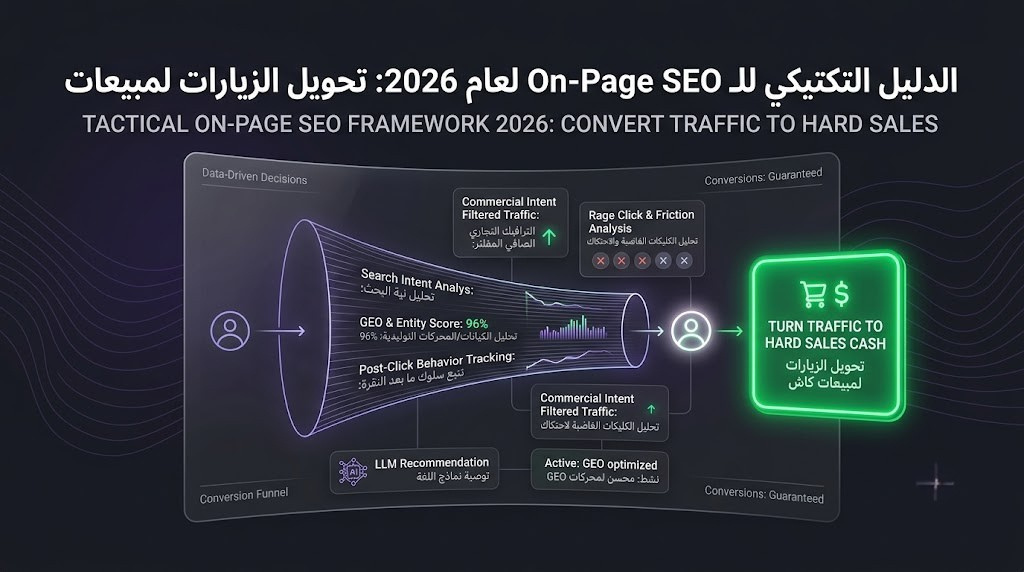
The Customer Journey on Google: Where Are the Real Sales Hiding?
Let’s imagine how a customer thinks before making a purchase. A customer does not simply wake up, open Google, and buy immediately. They go through a journey. The fascinating part of this journey is that their "search language" changes the closer they get to the moment of taking out their credit card and paying.
To understand where your actual revenue hides, let's observe the journey of a real customer looking for a solution to back pain:
Stage 1 (General Search): The customer feels pain, so they type a very broad, formal phrase into Google like: "Causes of back pain upon waking up." At this stage, the customer is only looking for information. The chances of them buying a product right now are almost zero.
Stage 2 (Comparison): The customer now understands their problem and starts looking for solutions, typing: "Best medical mattresses for back support." They are a step closer, but still in the phase of thinking and comparing brands and prices.
Stage 3 (The Buying Decision): The customer has made up their mind and wants to act now. Here, they drop the formal language and use their local dialect and city details, typing: "Where to find a cheap medical mattress in Riyadh" or "Medical bed mattresses Dammam same-day delivery."
What Does This Mean for Your Business? The secret lies right here: The keywords in the first stage have massive monthly search volumes, but they do not bring in sales. On the other hand, the keywords in the third stage (local and specific) have lower search volumes, but whoever searches with them is ready to pay instantly.
If all your website articles focus only on the first stage just to brag about high traffic, you are bringing in visitors who read the information and leave. True intelligence in SEO is targeting "Stage 3 keywords," because these are the exact search terms that increase your profits and boost your actual sales.
How to Write Content Google Actually Trusts? (The Secret to Beating Copycats)
In the age of AI, creating content has become effortless. Your competitors can now generate hundreds of articles with a single click. But what is the outcome? An internet flooded with identical, soulless, copy-pasted articles that offer absolutely nothing new to the customer.
Google quickly recognized this problem and updated its algorithms to look for one specific element that distinguishes powerful websites: "Information Gain."
What is Information Gain in Simple Terms? It means providing a unique piece of data, a statistic, or a real-world experience that literally no one else on the first page of search results possesses. The search engine is essentially asking: If your article is just a rewritten version of what everyone else has already said, why should I rank you first?
Practical Application: How to Prove You Are a Real Expert? Let’s assume you run a consulting firm and are writing an article about "Steps to Establish a Company in Saudi Arabia." The common mistake is to look at competitors and simply copy the Ministry of Commerce’s requirements. This is dead content.
The smart approach is to inject your actual market experience. Write a paragraph stating: "Through our experience establishing over 50 tech companies in Riyadh over the past year, we noticed that the biggest mistake delaying commercial registration for weeks is selecting a business activity that does not align with the license type..." and then provide the solution.
This simple sentence works like magic. It tells the search engine (and your customer) that you are not just parroting information; you are an active practitioner on the ground. This is the authentic human content that Google trusts, elevates far above automated copycat articles, and uses as the definitive, authoritative answer in search snippets.
The Difficult Equation: How to Speak the Customer's Language Without Losing Your Brand's Prestige
There is a highly legitimate fear among many business owners and executives. You have spent years building a professional corporate image and a premium brand, so how can search algorithms now demand that you write in a conversational dialect that might seem informal or unsuited to your company's status?
The secret lies entirely in "where" you place these words within your website's architecture, not in turning your entire platform into a casual chat room.
The Magic Solution: Exploiting the FAQ Section The smartest and safest tactic for preserving your brand's prestige is the "Frequently Asked Questions" (FAQ) section located at the bottom of your service pages or articles. This specific section is your safe space to represent the "voice of the customer," while the main body of the page firmly maintains your professional "corporate voice."
How to Apply This Practically? When structuring your FAQ section, frame the question using the exact conversational language your buyer types into Google. For example, instead of writing: "What is your scheduled payment policy?", write: "Can I split the payment without interest?" or "How do I guarantee this service will actually work?".
Then, your brand takes the stage. Write the answer directly beneath that question in your official, confident, and reassuring corporate tone: "Our contracts are strictly bound by clear performance indicators to ensure you achieve your goals, and we offer highly flexible payment distributions...".
Through this brilliant approach, you achieve two massive goals simultaneously: Google's NLP algorithms capture the conversational question and serve your website to the buyer who is ready to convert. The moment that buyer reads your answer, they immediately sense your company's high-level professionalism and trust you. You have not compromised your brand's authority; you have seamlessly integrated it with top-tier digital targeting.
Conclusion: From Vanity Metrics to Actual Revenue in Your Bank Account
In its modern form, SEO is no longer a technical checklist or a vanity contest to gather ghost traffic just to show off in monthly reports; it is a direct capital investment in your sales growth.
When you stop chasing broad, copied keywords and start speaking your customer's exact language at the crucial moment they decide to buy, you will instantly notice a massive difference in your conversion rates. The Saudi consumer is highly intelligent, Google's engine has become even smarter, and the only winner in this equation is the business that provides a real experience and content that solves problems with a human touch and tangible expertise.
You now hold the blueprint. You understand how the customer thinks and how Google reads those thoughts. The next step is not reading another article, but translating this knowledge into a solid infrastructure on your website or e-commerce store.
Your Next Move: To discover how to build your entire SEO strategy step-by-step—from the programmatic foundations to dominating the search results in the Saudi market—head over right now to read the [Comprehensive Guide to SEO in Saudi Arabia 2026], and let us start engineering your digital growth.