

Why Ranking on Google Is No Longer Enough
Let’s start with the reality every Saudi business owner understands.
For years, the goal was simple:
get your website on the first page of Google.
Whether you run a clinic in Riyadh, an e-commerce store in Jeddah, a real estate company in Khobar, a legal office, a training platform, or a B2B service company targeting Saudi decision-makers, search visibility used to mean one thing: ranking high on traditional search results.
The customer would search, open a few websites, compare options, and then decide who to contact.
That journey still exists, but it is no longer the full picture.
Today, people are not only searching with short keywords like:
SEO company in Saudi Arabia
Best digital marketing agency in Riyadh
How to improve my website ranking
SEO services for businesses
Website optimization Saudi Arabia
They are asking full, conversational questions:
How can I make my website appear on Google and ChatGPT?
Is my website ready to appear in AI-generated answers?
What is the difference between SEO and GEO?
How can my business get more visibility without relying only on ads?
Can my company appear in Gemini or Google AI Overviews?
This shift changes the rules.
The question is no longer only:
Does your website appear on Google?
The stronger question is:
Is your website clear, trusted, and structured enough to be used as a source inside AI-generated answers?
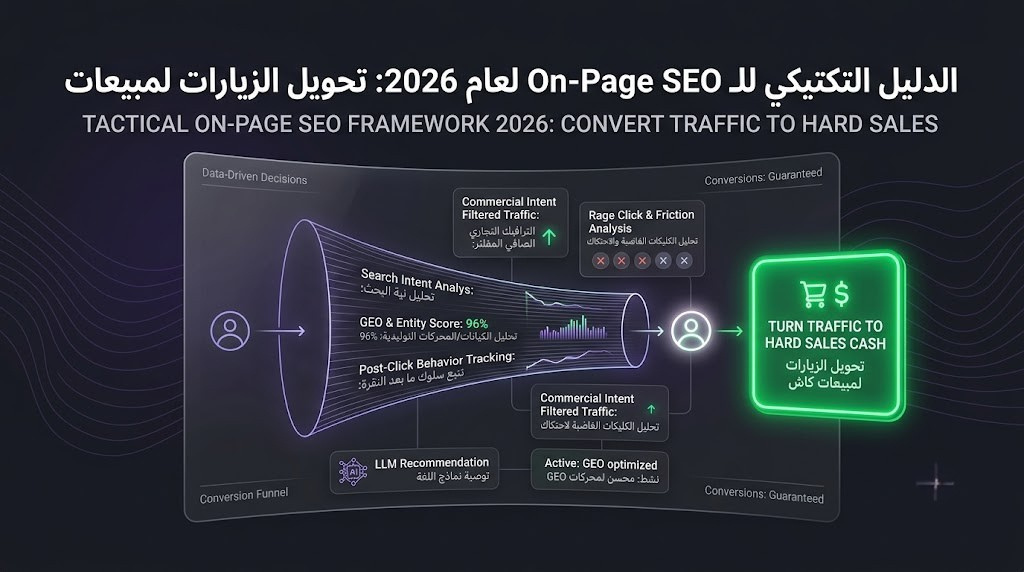
What Has Changed in the Search Journey?
Search is no longer a straight line.
In the traditional search journey, the user typed a keyword, scanned a list of blue links, opened several pages, and built their own understanding.
Now, part of that process is happening inside a single AI-generated response.
Google has already introduced AI-powered search experiences such as AI Overviews and AI Mode, which are designed to help users get summarized answers supported by information from the web. From a website owner’s perspective, Google explains that site owners should understand how their content may be included in these AI search experiences, not only in classic organic listings.
That means your website is no longer competing only for a ranking position.
It is also competing to become a trusted source that search engines and AI systems can understand, classify, and potentially use when forming an answer.
Traditional Search
In traditional search, the user sees a list of websites and decides which one to open.
Example search:
Best SEO company in Saudi Arabia
In this case, your title, meta description, ranking position, and brand trust influence whether the user clicks.
AI-Powered Search
In AI-powered search, the user asks a more detailed question, and the system tries to generate a direct answer.
Example search:
What is the best way for a Saudi service company to improve visibility on Google, ChatGPT, and Gemini?
Here, having a basic service page is not enough.
Your website needs to explain your expertise clearly. It needs to show who you serve, what problems you solve, why your information is reliable, and how your content connects to the user’s real search intent.
Why This Matters for Saudi Businesses
Saudi customers search before they buy, book, compare, or contact.
This applies across many sectors:
Medical clinics and healthcare providers
Real estate and construction companies
E-commerce stores
SEO and marketing agencies
Law firms and consulting offices
Education and training providers
Software companies and SaaS platforms
B2B service providers
Local service businesses across Riyadh, Jeddah, Dammam, Khobar, Makkah, and Madinah
According to StatCounter data for Saudi Arabia, Google holds the dominant share of the search engine market in the Kingdom, with Google listed at 95.39% for the May 2025 to May 2026 period. This makes every major change in Google’s search experience highly relevant for Saudi businesses that depend on organic visibility.
The Local Opportunity
The opportunity in Saudi Arabia is not only about traffic.
It is about trust.
Many Saudi businesses have strong services in the real world, but their websites do not explain that strength properly.
A company may have years of experience, excellent client results, and a strong team, but the website may still fail to answer basic questions such as:
Who exactly does the company serve?
What problem does it solve?
Why should the customer trust it?
What makes it relevant to the Saudi market?
How is it different from competitors?
What does the customer need to know before making a decision?
Are the service pages detailed enough?
Does the website answer real customer questions?
Is the content structured in a way that search engines can understand?
This is where many websites lose visibility.
Not because the business is weak, but because the website does not communicate its expertise clearly enough.

Where GEO Fits Into This Shift
GEO stands for Generative Engine Optimization.
It refers to improving the way your website appears, gets understood, and may be referenced inside AI-generated search experiences and answer engines such as ChatGPT, Gemini, Google AI Overviews, and similar systems.
But here is the important point:
GEO Does Not Replace SEO
GEO is not the death of SEO.
It is a more advanced layer built on top of strong SEO foundations.
Google’s own guidance makes this clear: SEO best practices remain relevant because Google’s generative AI features are still connected to its core Search ranking and quality systems. Google also explains that terms like AEO and GEO are often used to describe visibility work for AI search experiences, but from Google Search’s perspective, this is still part of optimizing for the search experience.
In simple terms:
If your website is slow, poorly structured, difficult to crawl, thin in content, or unclear in its messaging, it will not become a strong AI source just because you add words like “AI,” “ChatGPT,” or “Gemini” to your articles.
GEO starts with strong SEO, then goes deeper into clarity, context, trust, and answer quality.
GEO Is About Building Content That Can Be Understood
Instead of writing only for a keyword, GEO pushes you to write for:
Search intent
Topic clarity
Entity understanding
Brand credibility
Answer quality
Internal content relationships
Structured data
Source trust
Natural language relevance
The user’s real decision-making journey
This is the difference between a website that tries to rank and a website that deserves to be used as a source.
What Does Natural Language Processing Have to Do With GEO?
This is where Natural Language Processing, or NLP, becomes important.
AI systems do not read your article as a simple list of repeated keywords.
They try to understand meaning.
They look at the page and try to identify:
What is the main topic?
Is this page about a service, a problem, a location, a company, or a solution?
Which market does this business serve?
Is there a clear relationship between SEO, AI search, ChatGPT, Gemini, and Saudi Arabia?
Does the content answer the user’s question directly?
Is the information specific or generic?
Does the page show real expertise?
Is the website structured in a way that makes the answer easy to extract?
A Simple Saudi Example
Let’s say you run an SEO company in Riyadh.
A weak page might repeat:
We are the best SEO company in Riyadh.
Again and again.
That is not enough.
A stronger page explains:
How Saudi companies can improve organic visibility
What technical issues usually prevent websites from ranking
How search intent differs between informational and commercial queries
Why Arabic content needs semantic structure, not keyword stuffing
How service pages should be written for local customers
How schema, internal links, and authority signals support visibility
How a business can prepare for Google Search, ChatGPT, Gemini, and AI Overviews together
This kind of content is more useful for the reader and easier for search systems to understand.
You are not just repeating a keyword.
You are building meaning.
Why Keyword Repetition Is No Longer a Strategy
Old SEO often relied on repeating the same phrase too many times.
For example:
SEO in Saudi Arabia is important because SEO in Saudi Arabia helps companies looking for SEO in Saudi Arabia improve their SEO in Saudi Arabia.
This type of content does not build trust.
It does not help the customer.
It does not show expertise.
And it does not create the kind of clear, useful answer that modern search experiences are designed to surface.
What Strong Content Looks Like Today
Strong content today needs to be:
Clear
Specific
Helpful
Structured
Locally relevant
Supported by trusted sources
Written in natural language
Built around real customer questions
Connected to the broader topic
Useful for both readers and search systems
For Saudi readers, this matters even more.
A business owner in Riyadh or Jeddah does not want generic global advice that ignores the local market. They want to understand how the topic applies to their company, their industry, their city, their customers, and their growth goals.
The New Competition: From Ranking to Being Referenced
The competition is no longer only about being number one on Google.
It now happens on three levels.
1. Appearing as a Search Result
This is traditional SEO.
Your goal is to appear when a customer searches for a service, product, or problem related to your business.
2. Being Recognized as a Trusted Source
This is where the shift begins.
Your content must be detailed, credible, and structured enough for search engines to understand what you are an authority on.
3. Being Included in AI-Generated Answers
This is the heart of GEO.
At this level, your brand is not just one link in a long list.
It becomes part of the answer.
That is a much stronger position.
Because when an AI-powered search experience uses your content as a reference point, your website is no longer only competing for attention. It is competing for trust.
What This Means for a Website Owner in Saudi Arabia
For Saudi businesses, the next stage of search is not just about publishing more content.
It is about building a stronger digital asset.
Your website needs to explain your expertise in a way that is useful to customers and understandable to search systems.
Your Website Should Clearly Show:
Who you are
What services you offer
Which customers you serve in Saudi Arabia
What problems you solve
Why your company is trustworthy
How your process works
What makes you different from competitors
What customers usually ask before contacting you
How your services connect to real business outcomes
Why your content deserves to be trusted
These details may look simple, but they have a major impact on how both people and algorithms understand your business.
Key Takeaway
Ranking on Google still matters.
It matters a lot.
But in 2026, strong search visibility is no longer only about appearing as a blue link.
A strong website should be able to do three things at the same time:
Appear in traditional search results
Help Saudi readers with clear, useful, locally relevant content
Become structured and trustworthy enough to be understood by AI-powered search systems
So the question is no longer only:
How do I rank higher on Google?
The better question is:
How do I make my website the source that Google, ChatGPT, and Gemini can understand when my customer is looking for an answer?
That is where GEO begins.
Not as a replacement for SEO, but as the next stage of it.
A stage where your website is not only trying to appear as a result.
It is built to become a trusted answer.